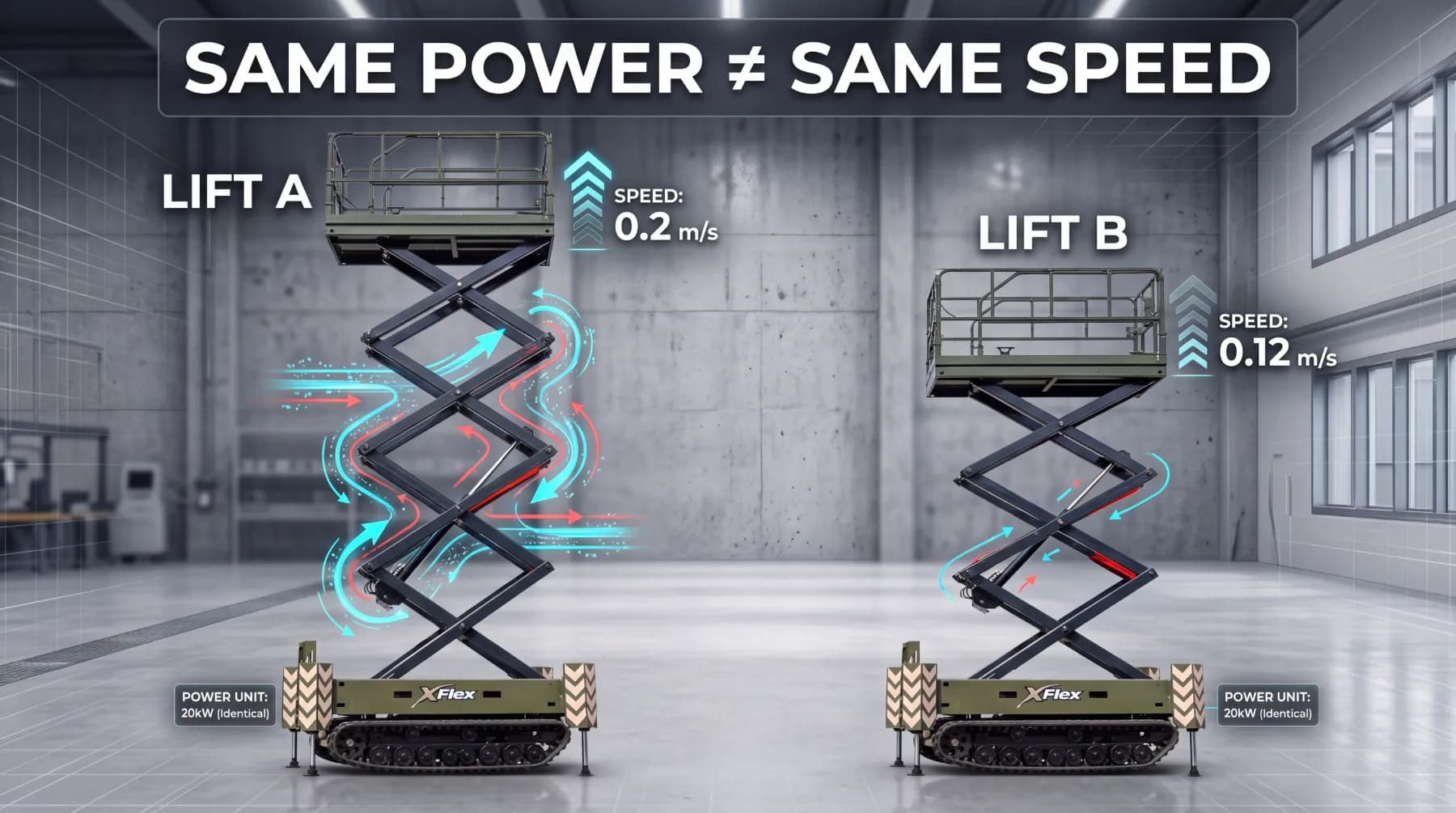
At first glance, two scissor lifts rated with the same engine or motor power should behave the same way on the jobsite. Yet operators often notice one platform climbing noticeably faster than another, even when the spec sheets look nearly identical. The reason comes down to how each machine moves hydraulic fluid, sizes its components, and manages the demands of a real working load. Understanding these differences helps you choose the right lift for the pace and productivity your projects require.
Hydraulic Flow Determines Lift Speed
Power tells only part of the story. What actually raises a scissor lift platform is hydraulic fluid moving into the lifting cylinders, and the rate of that movement is called flow. Flow is measured in units like gallons per minute or liters per minute, and it directly controls how fast the cylinders extend. A machine that pushes more oil into the cylinders in the same amount of time will lift its platform faster, even if the two lifts share the same horsepower rating.
Think of it like filling two buckets from two garden hoses. Both hoses might be connected to the same water supply, but the wider hose delivers more water per second and fills its bucket sooner. Hydraulic flow works in a similar way. The pump determines how much fluid reaches the cylinders each second, and a higher flow rate translates into a quicker lift cycle.
This is why flow rate deserves close attention when comparing machines. Two lifts can advertise the same power because their motors or engines are equally strong, but the pump paired with that motor may be tuned for different priorities. One manufacturer might favor faster cycle times with a high-flow pump, while another might favor smoother, slower motion for stability. The horsepower figure alone will not reveal this. To predict real lifting speed, you need to look at the flow the hydraulic system can actually deliver to the cylinders during operation, not just the power that drives the pump.
Cylinder Size Changes How Fast the Platform Moves
The dimensions of the hydraulic cylinders play a major role in lifting speed, and this is where two similarly powered machines can diverge sharply. A cylinder's bore, or internal diameter, determines how much fluid it takes to extend the piston a given distance. A larger-diameter cylinder holds more volume, so it needs more oil to move the platform the same height compared with a narrower cylinder.
This creates a natural trade-off. A wide cylinder generates greater lifting force because pressure acts across a larger surface area inside the barrel. That extra force is valuable when raising heavy loads. However, the same wide cylinder demands more fluid to fill, and if the pump delivers oil at a fixed rate, the larger cylinder will extend more slowly. A narrower cylinder fills faster and moves the platform up more quickly, but it produces less force for the same pressure.
Manufacturers balance these factors based on how they expect the lift to be used. Consider the two priorities at play:
- Force-focused design: larger cylinders provide the muscle to handle heavier rated capacities, often at the cost of a slightly slower lift.
- Speed-focused design: smaller or optimized cylinders reduce the fluid volume required per stroke, allowing quicker platform movement.
Because of this, two lifts with matching motor power can still perform very differently. If one uses larger cylinders to meet a higher weight rating, its lifting cycle may take longer even though it feels every bit as strong. The cylinder dimensions, working alongside flow rate, quietly shape the speed you actually experience on site.
Hydraulic Pressure Is Not the Same as Hydraulic Flow
Pressure and flow are frequently confused, yet they describe two different things, and mixing them up leads to inaccurate expectations about performance. Pressure, measured in units like psi or bar, represents the force the hydraulic system can apply. It determines how much weight the lift can raise and how hard the cylinders can push. Flow, by contrast, describes how much fluid moves through the system over time, and it governs how quickly the cylinders extend.
A helpful way to picture the distinction is to separate strength from speed. Pressure is the strength behind the lift, while flow is the speed of the motion. A machine can be very strong yet lift slowly, or it can lift quickly while handling a lighter maximum load. These qualities are set by different parts of the hydraulic system and do not automatically rise or fall together.
This explains a common source of confusion when comparing spec sheets. Two scissor lifts might list identical maximum pressure ratings, suggesting they can generate the same lifting force. Buyers sometimes assume matching pressure means matching speed as well. In reality, the two machines may run entirely different flow rates. One could pair its pressure rating with a high-flow pump for rapid lifting, while the other pairs the same pressure with a lower flow rate for gentler, more controlled movement.
Reading only the pressure figure hides these differences. To understand how a lift will actually perform, you have to consider pressure and flow together. Pressure confirms the machine can handle the load, and flow reveals how quickly it will raise that load into position.
Load Weight Affects Actual Lifting Speed
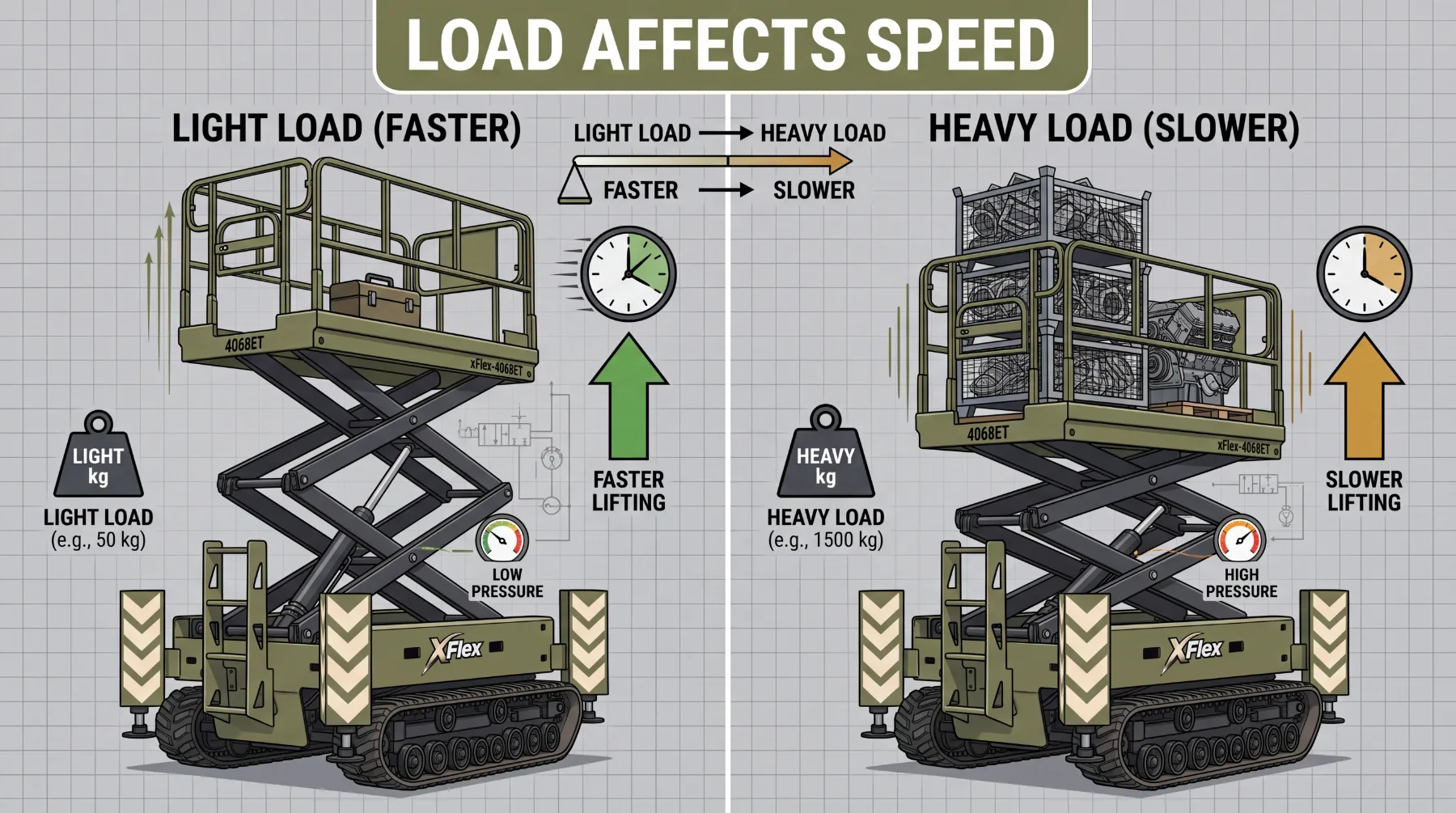
Advertised lift speeds are usually measured under specific, controlled conditions, and those conditions may not match your daily workload. A manufacturer might quote a lifting time based on an empty platform or a light test load. Once you place a full crew, tools, and materials on the deck, the real lifting speed can change noticeably, and the heavier the load, the more pronounced the effect tends to be.
The reason lies in how the hydraulic system responds to resistance. When the platform carries a heavy payload, the cylinders must generate more force to overcome that weight and keep climbing. The system pressure rises to meet the demand. As the hydraulic components work harder against greater resistance, the effective lifting cycle often slows compared with the lightly loaded figure printed in the brochure. The pump and cylinders are simply pushing against more opposition.
This is why comparing two machines fairly means comparing them under similar load conditions. A lift that appears fast on paper may lose much of that advantage when it is working near its rated capacity, while a machine designed with extra hydraulic headroom might hold its speed better as the load increases. The published number reflects a best-case scenario, not necessarily the pace you will see with a fully loaded platform.
For operators planning productivity, it helps to think about the typical weight the lift will carry rather than the empty-deck spec. Ask how the machine performs at realistic loads and whether its lifting time was measured loaded or unloaded. Real-world speed depends heavily on the payload, and two lifts with similar power can separate quickly once genuine working weight enters the equation.
Hydraulic System Design Affects Overall Performance
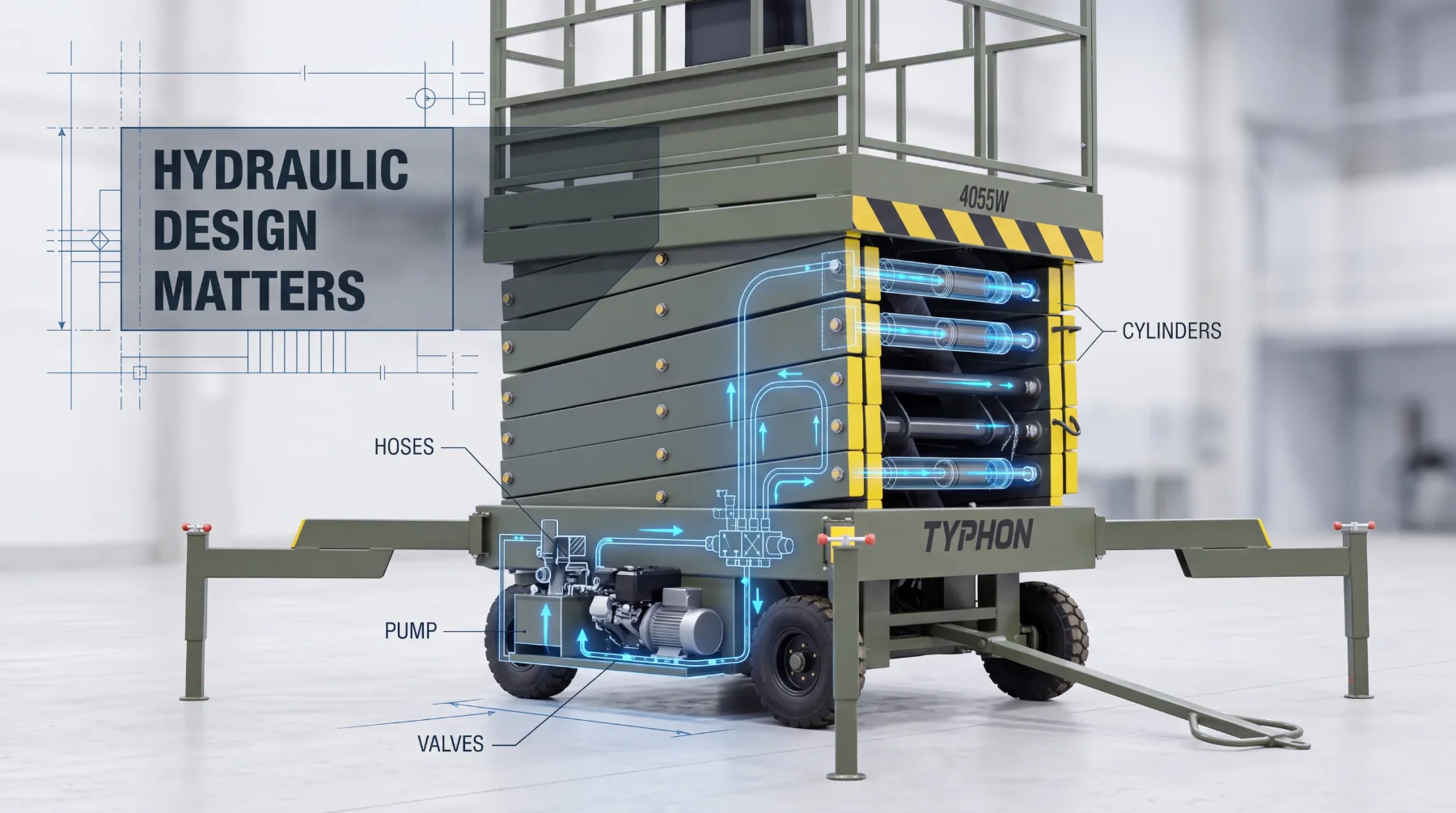
Even after accounting for flow, cylinder size, pressure, and load, differences in lifting speed remain, and they trace back to how the entire hydraulic system is engineered. A scissor lift is a network of components working together, and the way that network is designed shapes how efficiently oil travels from the pump to the cylinders. Small design choices add up to meaningful differences in cycle time.
Several elements contribute to this overall performance:
- Pump efficiency: a well-matched, efficient pump delivers its rated flow with fewer losses, keeping the lift responsive.
- Valve design: the type, size, and placement of control valves affect how freely fluid moves and how smoothly the platform starts and stops.
- Hose and line sizing: narrow or long hoses create resistance that slows fluid delivery, while properly sized lines let oil flow with less restriction.
- Circuit layout: the overall arrangement of the hydraulic circuit influences how directly and quickly oil reaches the cylinders.
Each of these factors introduces friction or efficiency into the system. When fluid has to squeeze through undersized hoses or navigate a restrictive valve, some of the pump's output is lost to internal resistance rather than converted into platform movement. A lift with a thoughtfully engineered circuit wastes less energy and reaches its working height sooner.
This is the reason two machines with identical power ratings can still post very different cycle times. One might be built around an efficient, well-integrated hydraulic system that maximizes every bit of flow, while the other carries design compromises that slow the fluid on its way to the cylinders. The horsepower figure never captures these details. Real lifting performance emerges from how well all the hydraulic components are designed to work as a single, coordinated system.
Frequently Asked Questions
1. Why does my scissor lift slower than another model with the same horsepower?
Horsepower describes the power driving the pump, not how fast fluid reaches the lifting cylinders. Lifting speed depends on hydraulic flow rate, cylinder size, hose and valve design, and the load on the platform. Two machines with equal horsepower can have very different flow rates and hydraulic layouts, which is why one may raise its platform noticeably faster than the other despite matching power figures.
2. Does higher hydraulic pressure make a scissor lift rise faster?
Not directly. Pressure controls the force available for lifting, which relates to how much weight the machine can handle. Speed comes from flow, meaning how much fluid moves into the cylinders each second. A lift can have high pressure yet rise slowly if its flow rate is low. To gauge speed, look at flow; to gauge lifting capacity, look at pressure. Both matter, but they measure different things.
3. Will a heavier load slow down my lift's platform speed?
Yes. Advertised lift speeds are often measured with a light or empty platform. When you add a full load of crew, tools, and materials, the cylinders must work harder to overcome the extra weight, and the lifting cycle typically slows. The heavier the payload, the more noticeable this effect becomes. Comparing machines under similar, realistic load conditions gives a far more accurate sense of everyday performance.
4. How do hydraulic cylinder dimensions influence lifting speed?
The cylinder bore determines how much fluid is needed to extend the piston. Larger cylinders produce more lifting force but require more oil to fill, which can slow the lift if the flow rate stays constant. Smaller cylinders need less fluid and can move the platform faster, though they generate less force at the same pressure. Manufacturers size cylinders to balance the force and speed a machine is built to deliver.
5. What hydraulic components should I compare when evaluating lift speed?
Look beyond the power rating and examine the flow rate, cylinder bore, and system pressure together. Also consider pump efficiency, valve design, hose sizing, and the overall hydraulic circuit layout, since these affect how freely oil reaches the cylinders. Ask whether the quoted lift speed was measured loaded or unloaded. Reviewing these details as a complete package gives you a realistic picture of how quickly a machine will perform on the job.