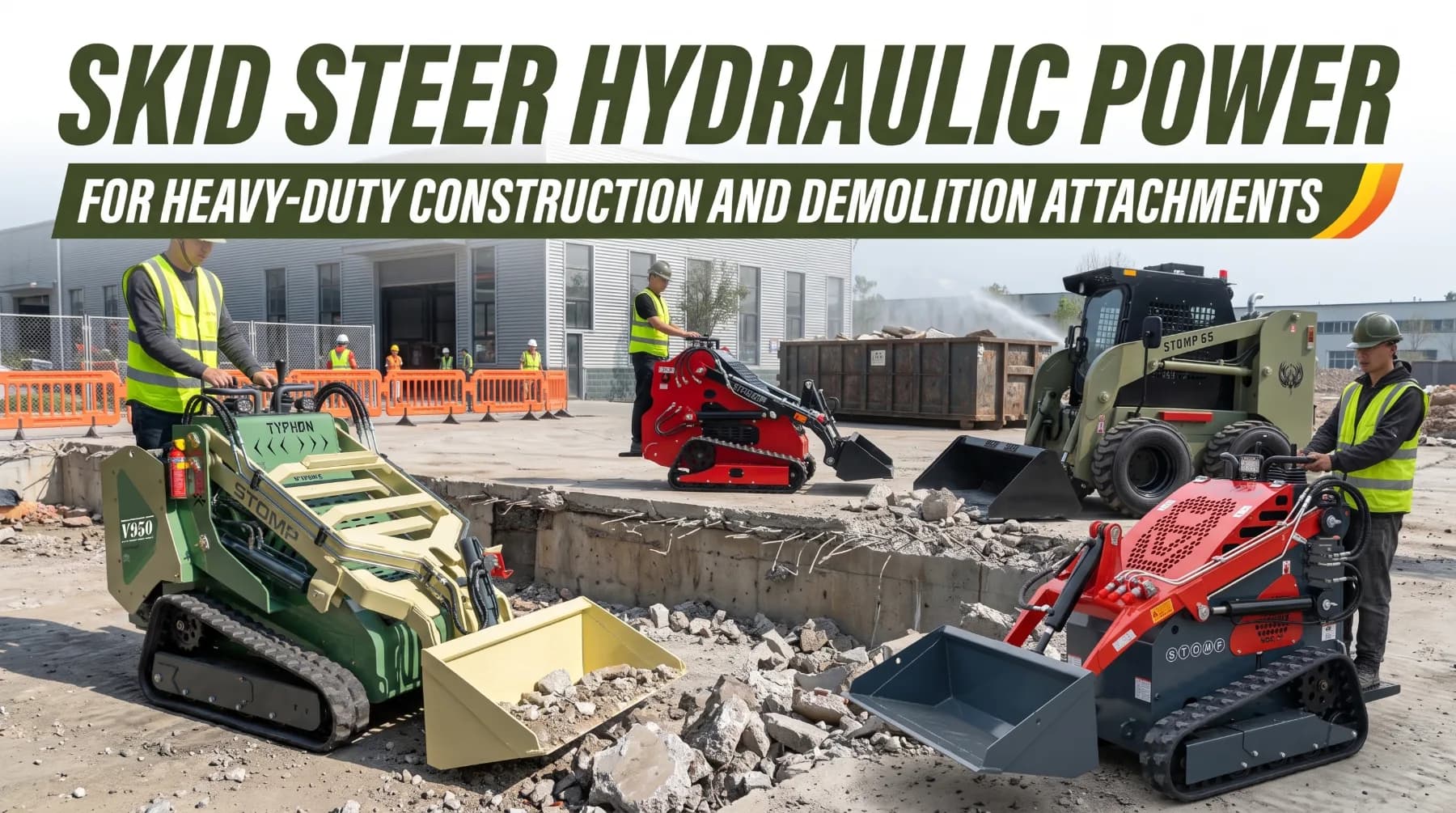
A demolition contractor arrives at a commercial renovation to remove an old concrete loading dock, break out interior slabs, and clear the rubble before the new foundation work begins. One skid steer will handle most of it. In the morning it runs a hydraulic breaker on the dock walls. By noon it switches to a concrete crusher to separate rebar. In the afternoon a grapple loads debris into roll-off containers. Each tool depends on the same hydraulic system, and each one places a different demand on it.
Skid steer loaders can take on a wide range of construction and demolition tasks when they are paired with compatible hydraulic attachments. Breakers, grapples, crushers, shears, and other heavy-duty tools work at their best only when the loader supplies the flow, pressure, and cooling they require. When the loader and attachment are well matched, you get strong breaking power, fast cycles, and long component life. When they are mismatched, you get stalled tools, overheated oil, and expensive repairs. This guide helps contractors build carrier and attachment combinations that work reliably on demanding jobs.
Understand Hydraulic Flow and Pressure
Every hydraulic demolition attachment runs on two specifications: flow and pressure. Flow, measured in gallons per minute (GPM), is the volume of oil the loader delivers to the attachment over time. It decides how fast a breaker strikes, how quickly crusher jaws close, and how fast a grapple clamps down on a load. Pressure, measured in pounds per square inch (PSI), contributes to the force the attachment produces. It shapes how hard a breaker hits, how much crushing force a pulverizer applies, and how firmly a grapple holds.
Every attachment manufacturer publishes an operating range for flow and pressure. Staying inside that range is essential. A breaker that receives too little flow strikes slowly and loses productivity. One that receives too much flow can overspeed its internal piston, run hot, and wear seals and bushings early. Pressure beyond an attachment's rating can stress hoses, seals, and motors, while pressure below it reduces breaking and crushing force.
Some demolition attachments also have return-line and case-drain requirements. Hydraulic breakers often perform best with low return-line restriction, and some manufacturers recommend a direct return to the tank. Attachments driven by hydraulic motors, such as cold planers and wheel saws, may require a case-drain line that gives internal leakage oil a low-pressure path back to the tank. Without it, pressure can build inside the motor housing and damage the shaft seal. Confirm these needs before connecting any attachment.
Key takeaway: Flow sets attachment speed and pressure contributes to force. Keep both inside the attachment manufacturer's rated range, and confirm any return-line or case-drain requirements before connecting.
Compare Standard and High-Flow Capability
Skid steers generally ship with a standard-flow auxiliary hydraulic system, and many models offer high flow as an option. The difference is the volume of oil the auxiliary circuit can supply. That volume determines which demolition tools the loader can run efficiently and which ones it can't run at all.
Avoid assuming that every demolition tool needs high flow. Sending more oil than an attachment is designed for can overspeed it, generate excess heat, and shorten its life. Some loaders let operators adjust auxiliary flow, and some attachments include flow control valves to limit incoming oil, but these solutions only work within their rated limits. Review the tools your crews run today and the ones you plan to add over the next few years. Buy high flow when that attachment lineup actually requires it, and confirm the attachment's operating range rather than its category.
Key takeaway: Standard flow runs most skid steer breakers, grapples, and crushers, while high flow powers cold planers, saws, and other high-demand tools. Choose the system that matches your attachment lineup, not the heaviest option available.
Select Tools for Specific Demolition Tasks
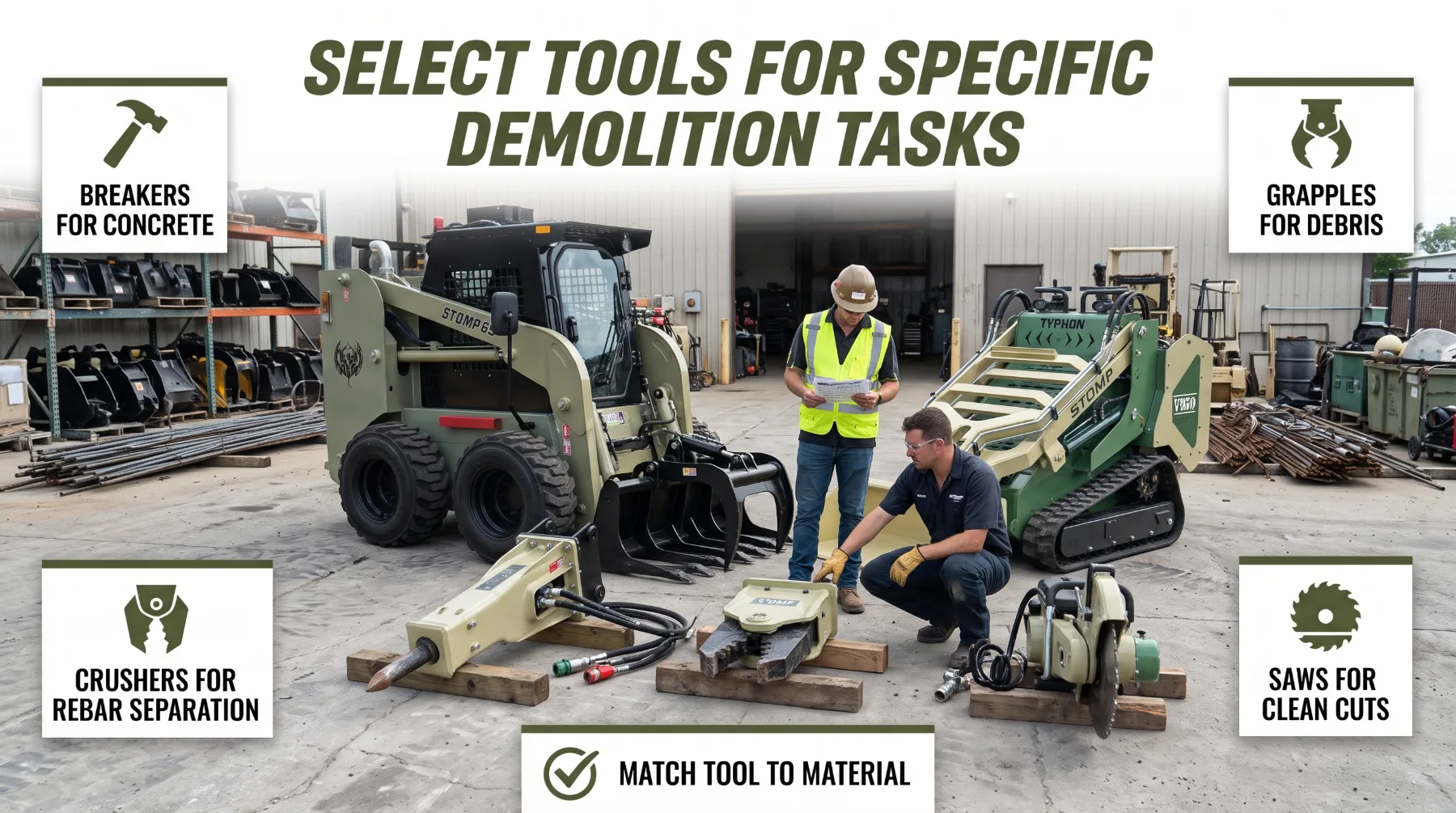
The right tool depends on the material, the structure, and the result you need. Each common demolition attachment is designed for a specific type of work, and using it outside that purpose reduces productivity and increases risk.
Hydraulic breakers handle concrete slabs, footings, walls, masonry, asphalt, and suitable rock. They work by driving an internal piston into a tool bit, delivering rapid, high-energy blows. Choose a breaker sized for the loader's operating capacity and hydraulic output, and pick the tool bit for the job. A moil point suits general breaking and penetration, a chisel works well for trenching and splitting, and a blunt tool helps on hard, brittle material. Keep the bit perpendicular to the surface, break from the edge of a slab inward, and reposition every 15 to 30 seconds if the material isn't fracturing. Avoid blank firing, which happens when the breaker strikes without the bit pressed firmly against material, since it damages internal components. Never use a breaker to pry, lift, or rake debris. Grease the tool bit at the intervals the manufacturer specifies, often every couple of hours of operation.
Grapples handle debris, scrap, logs, and bulky material that a bucket can't control. A demolition grapple uses heavy tines and hydraulic clamps to hold irregular loads securely, which makes it well suited to loading containers, sorting debris, and clearing rubble. Root grapples work well for brush and mixed debris. Check that the grapple's cylinders, hoses, and tines are protected from impact, and confirm clamp force and opening width for the materials you handle. Keep loads low during travel, and never swing a raised load over people or vehicles.
Concrete tools cover cutting, crushing, and processing. Concrete crushers and pulverizers break reinforced concrete into manageable pieces and help separate rebar for recycling, with less noise and vibration than a breaker. Shears cut rebar, light steel, and metal debris. Cold planers mill asphalt and concrete surfaces to a set depth, and wheel saws or rock saws cut clean lines through pavement for utility work. Many of these tools require high flow, so confirm their requirements carefully. Select each tool based on the material and the manufacturer's approved application, and keep a breaker or crusher matched to the thickness and reinforcement of the concrete you expect.
Key takeaway: Use breakers for impact breaking, grapples for debris handling, and crushers, shears, planers, or saws for processing and cutting. Match each tool to the material, and never use a breaker to pry or lift.
Match the Attachment to the Machine
A demolition attachment can only perform as well as the loader carrying it. Compatibility involves more than hydraulic figures. Mounting, weight, couplers, electrical connections, and operator protection all have to line up before the combination is ready for work.
Start with mounting. Most skid steers use a universal quick-attach plate, but confirm that the attachment's mounting plate fits your loader's coupler and that the locking pins or wedges fully engage. Then review hydraulic couplers. They must be the correct type and size, clean, and fully seated. Many modern loaders use flat-face couplers, which reduce spillage and keep contamination out when wiped clean before connecting. If the attachment needs an electrical harness for functions such as jaw rotation or tilt, confirm that the loader's connector and control system support it.
Weight deserves close attention. Demolition attachments are often heavy, and their weight counts against the loader's rated operating capacity. Rated operating capacity is set as a percentage of tipping load, commonly 50% for wheeled skid steers and 35% for compact track loaders under industry standards. A heavy breaker or crusher reduces the payload margin and moves the machine's center of gravity forward, especially with the lift arms raised. That shift affects stability on slopes, uneven rubble, and soft ground. Check the attachment's weight against the loader's rated operating capacity, and consider how the machine will behave with the arms extended during real work.
Operator protection is part of the match. Demolition creates flying debris and falling material, so confirm that the loader is equipped with the guarding the manufacturer specifies for the application, such as a falling object protective structure, a polycarbonate or reinforced front door, and side screens. Never modify the cab or protective structure to fit an attachment. For the most reliable result, ask the dealer or attachment manufacturer to confirm compatibility in writing for your exact loader model, then test the combination on representative material before committing to a large job.
Key takeaway: Confirm mounting fit, coupler type, electrical needs, attachment weight against rated operating capacity, and the operator guarding required for demolition before putting any combination to work.
Monitor Heat and Hydraulic Condition
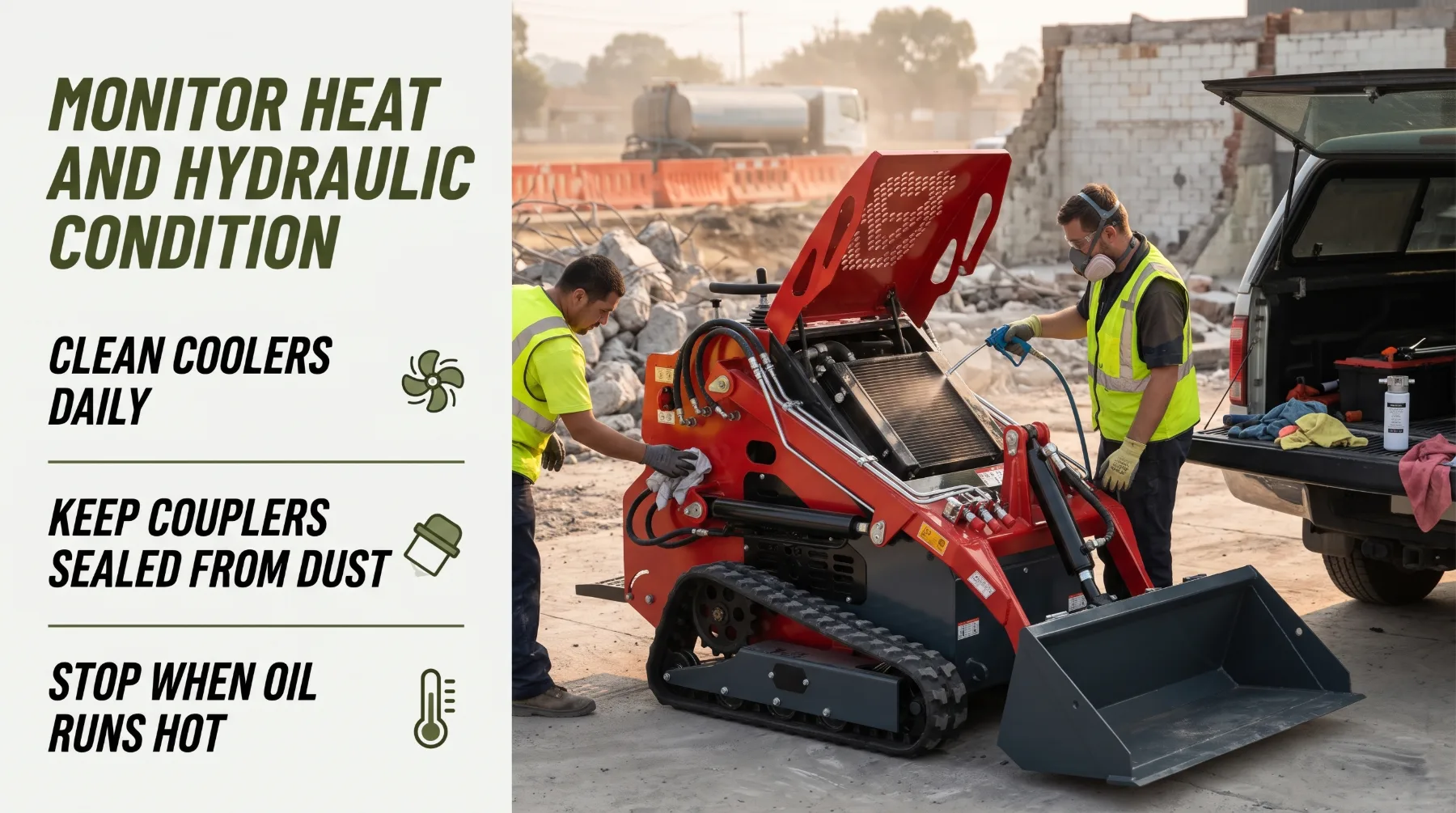
Demolition work is hard on a hydraulic system. A breaker or cold planer can run almost continuously for long stretches, and that sustained demand produces heat. Heat is one of the leading causes of hydraulic component wear, and demolition sites add dust and debris that make cooling harder.
As hydraulic oil gets hotter, it thins and loses some of its ability to lubricate and seal. Internal leakage increases, efficiency drops, and the system generates even more heat. Over time, high temperatures harden and crack seals, speed up oxidation of the fluid, and shorten the life of pumps, motors, and hoses. Watch the hydraulic temperature gauge or warning lights throughout the shift. If the system runs hot, reduce the load, pause to let it cool, and investigate the cause rather than pushing through. Persistent overheating often points to a flow mismatch, excessive return-line restriction, a clogged cooler, or low fluid.
Keep the cooling package clean. Concrete dust, drywall, insulation, and fine debris pack into radiator and hydraulic cooler fins quickly, which reduces airflow. Clean the coolers daily on demolition jobs, and more often in heavy dust. Use compressed air or water as the manufacturer recommends, working from the clean side outward. Confirm the cooling fan works properly and that the engine compartment is free of built-up debris, which can also become a fire hazard.
Contamination is the other major threat. Breakers in particular can introduce contaminants into the system, and dusty sites make every coupler connection a potential entry point. Wipe couplers clean before connecting them, and cap or plug them when the attachment is removed. Many manufacturers recommend shorter hydraulic filter intervals when running a breaker, so check your manual and adjust your schedule. Check fluid level and condition daily, using only the specified fluid, and watch for milky, dark, or burnt-smelling oil. Inspect hoses for abrasion and leaks before every shift, and replace damaged hoses before operating. Never use your hand to search for a leak, since pressurized fluid can penetrate skin and cause severe injury.
Key takeaway: Watch hydraulic temperature, clean coolers daily on demolition sites, keep couplers sealed from dust, shorten filter intervals for breaker work, and stop to investigate any overheating or leakage.
Apply Safe Operating Procedures
Demolition combines heavy machinery, flying debris, falling material, dust, and noise, often inside partially standing structures. Safe operation depends on planning before the first strike and disciplined habits throughout the shift.
Plan the work before starting. In the United States, OSHA requires an engineering survey before demolition begins to assess the condition of the structure and the risk of unplanned collapse. Confirm that electrical, gas, water, and other utilities have been shut off, capped, or otherwise controlled. Identify hazardous materials such as asbestos or lead-based paint, and make sure they are addressed by qualified personnel before mechanical demolition. Plan the sequence of work so the loader never operates beneath unsupported walls, overhead slabs, or material that could fall onto the machine.
Inspect the attachment and loader before every shift. Check the attachment for cracks, worn bushings, damaged hoses, and loose or missing pins. Confirm the quick coupler is fully engaged by visually checking that the locking pins extend completely through the mounting slots. Test the seat belt, restraint bar, interlocks, lights, and alarms, and confirm that doors, screens, and guarding are intact. Report any defect and keep the machine out of service until it is repaired.
Establish exclusion zones around the work area. Breakers and crushers can throw concrete fragments a considerable distance, and grapples can drop material. Keep ground workers well outside the zone while attachments are running, and mark it with barriers or cones. Use agreed hand signals or radios, and use a trained spotter when visibility is limited. Never allow anyone to stand under a raised attachment or load.
Protect everyone from dust and noise. Breaking and crushing concrete can release respirable crystalline silica, which poses serious health risks with prolonged exposure. Use water suppression at the point of breaking, keep cab doors closed and filters maintained, and follow applicable silica exposure requirements, such as the OSHA silica standard in the United States, including any required respiratory protection. Provide hearing protection, safety glasses, hard hats, gloves, and high-visibility clothing. Operators should always wear the seat belt, keep loads low while traveling, and follow the operating instructions for both the loader and the attachment.
Key takeaway: Survey the structure and control utilities before work begins, inspect the machine and attachment every shift, enforce exclusion zones, and control silica dust and noise to protect everyone on site.
Conclusion
Hydraulic power determines which heavy-duty attachments a skid steer can operate effectively and how reliably the equipment performs over time. Hydraulic flow and pressure must stay within each attachment’s rated range. Standard-flow systems support many breakers, grapples, and crushers, while high-flow systems are designed for demanding tools such as cold planers and saws. Attachment weight, mounting dimensions, couplers, and operator guarding must also match the loader, and each tool should be used only for its intended application. Proper maintenance helps protect the hydraulic system during extended demolition work. Keep coolers clean, maintain sealed couplers, follow appropriate filter service intervals, and monitor oil temperature closely. Job planning, equipment inspections, exclusion zones, and dust control also help protect workers. List the attachments required for the project and compare their flow, pressure, return-line, case-drain, and weight requirements with the loader’s specifications and cooling capacity. Confirm compatibility in writing for the exact models, then test the setup on representative material. Careful matching, testing, and maintenance help deliver dependable hydraulic performance while keeping demolition work safe and productive.
Frequently Asked Questions
What hydraulic specifications matter for demolition attachments?
Flow rate, operating pressure, return-line requirements, and any case-drain needs are the most important. Attachment weight relative to the loader's rated operating capacity also matters for safe, stable operation.
Does every demolition attachment require high flow?
No. Most skid steer breakers, demolition grapples, and many concrete crushers run on standard flow. Cold planers, wheel saws, and some large processors typically need high flow. Requirements depend on the attachment design and manufacturer specifications.
Why is hydraulic cooling important?
Continuous demolition work generates sustained heat. Effective cooling keeps oil within its operating range, which protects seals, slows fluid breakdown, and maintains attachment performance. Clean coolers daily on dusty sites.
Can a heavy attachment affect skid steer stability?
Yes. Attachment weight counts against the loader's rated operating capacity and shifts the center of gravity forward, especially with the lift arms raised. Keep loads low and stay within rated limits on slopes and uneven ground.