
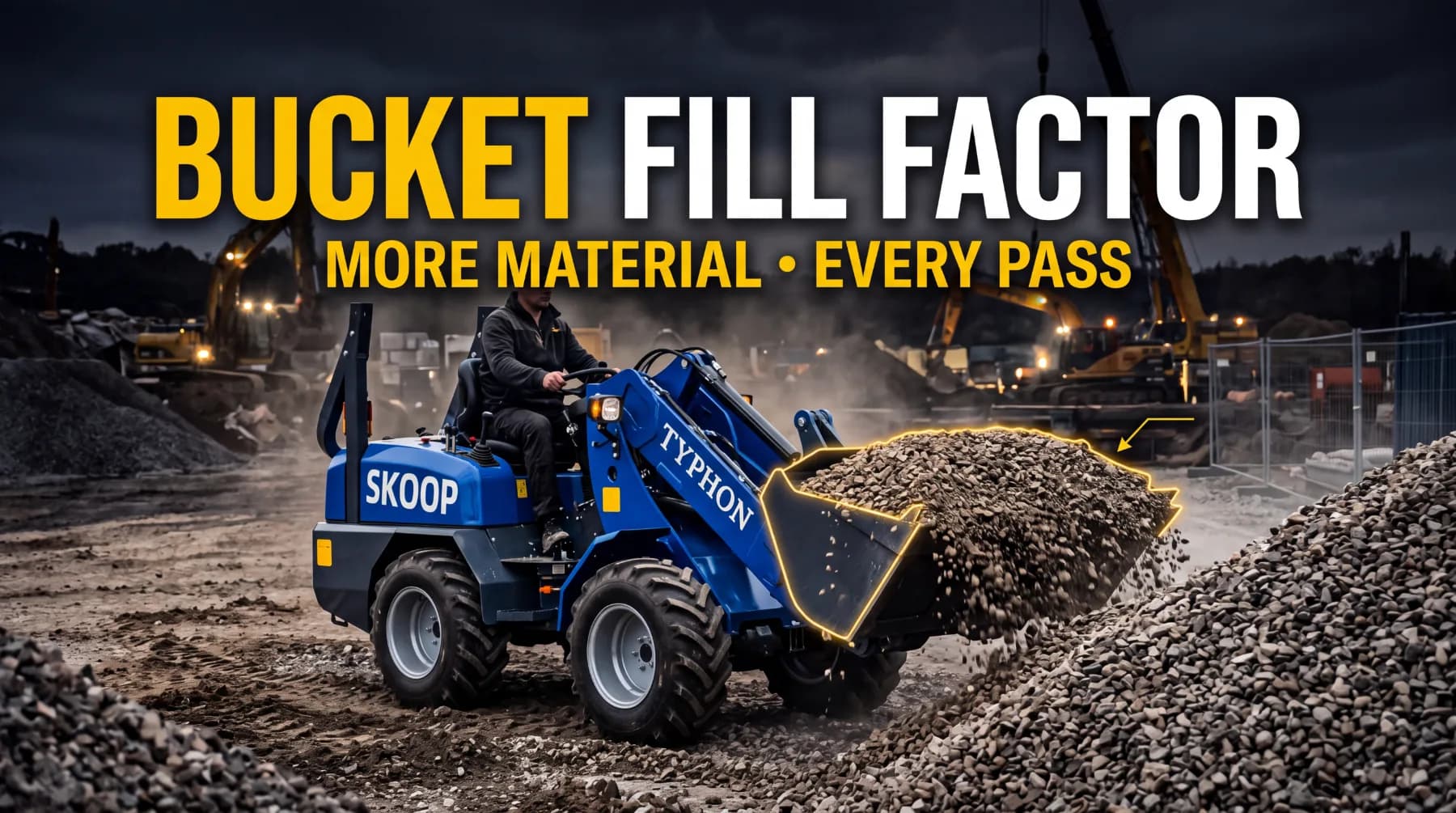
A wheel loader's productivity often comes down to a detail that is easy to overlook: how full the bucket actually is on each pass. A machine can have the right capacity, a capable engine, and a skilled operator, yet still fall short of its potential if the bucket rarely fills the way it should. Bucket fill factor captures this reality, and understanding it helps you get more from the machine you already own without spending a cent on upgrades.
This guide explains how bucket fill factor affects wheel loader productivity across five key areas. You will learn what fill factor is and why it matters, how different materials behave when loaded, how bucket design shapes filling, how operator technique influences results, and how fill factor combines with other factors to determine total output. By the end, you will see how better bucket utilization translates directly into more material moved.
What Is a Bucket Fill Factor?
Bucket fill factor describes how much of a bucket's rated volume is actually filled with material during a loading cycle. Every bucket carries a rated capacity, but that figure represents an ideal rather than a guarantee. In real working conditions, the bucket may come out of the pile carrying more or less than its rated volume, and the fill factor expresses that actual load as a proportion of what the bucket is designed to hold. A bucket filled to its full rated volume reaches a fill factor of one hundred percent, while one that comes up short sits below that mark.
The reason this matters is simple: the more of the bucket's capacity you use on each pass, the more material you move per cycle. A higher effective fill means each trip from the pile to the truck carries a larger payload, so the machine accomplishes more work in the same number of cycles. Over a full shift, this difference compounds into a significant gain in total output.
Consider two loaders with identical rated bucket capacities working the same material. If one consistently achieves a higher fill factor than the other, it moves more material per cycle, completes the job sooner, and uses less fuel per ton handled. The machine has not changed, yet its productivity has, purely because the bucket is being used more fully.
- Rated capacity sets the bucket's designed volume
- Actual fill reflects what the bucket really carries each pass
- Fill factor measures actual fill against rated capacity
Understanding the fill factor gives you a practical lens for judging real productivity, since it reveals how much of a machine's capability is genuinely being put to work.
Material Type Influences Bucket Filling
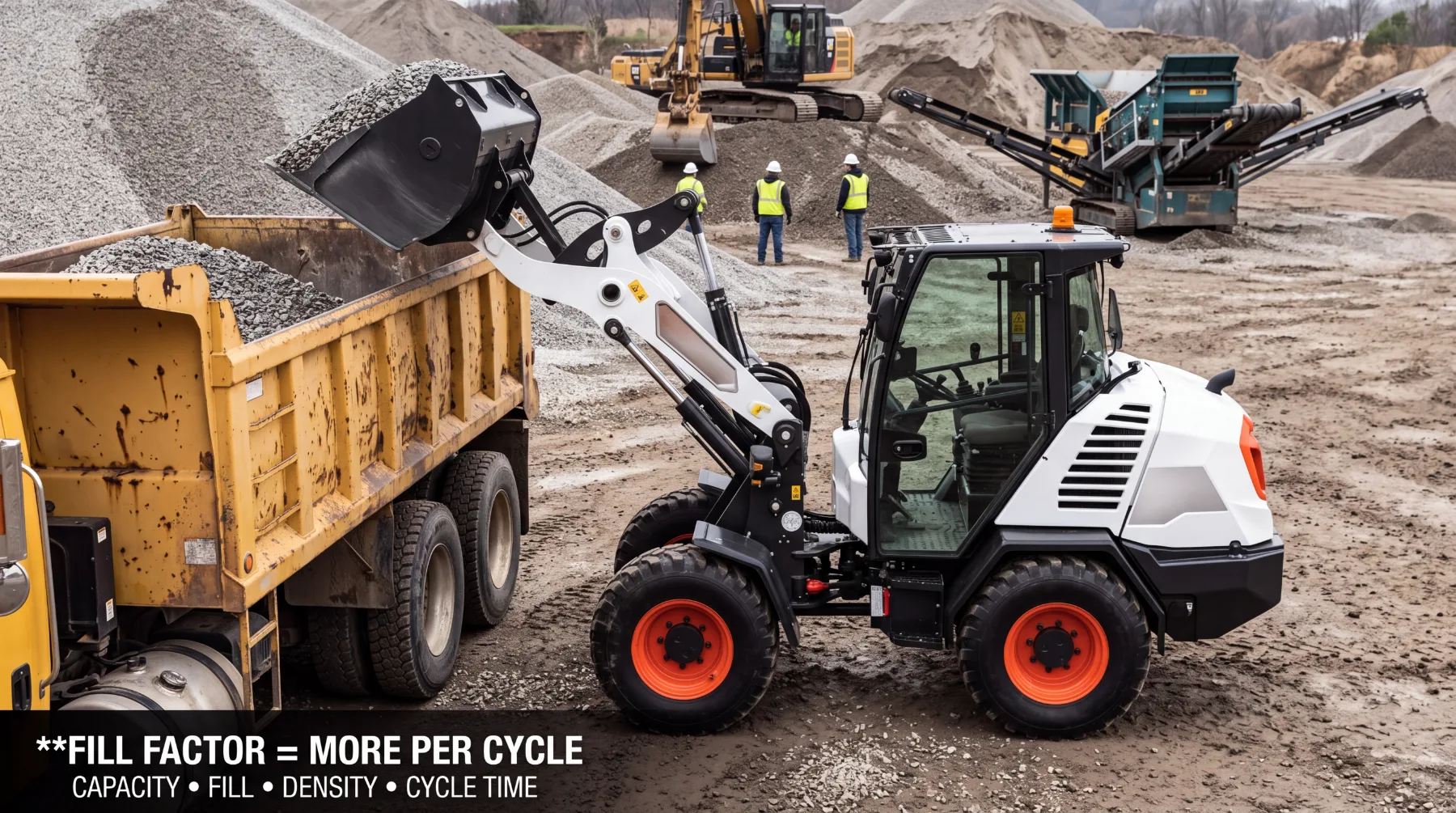
Loose soil, gravel, sand, and other materials each behave differently when loaded, and those differences have a direct effect on how easily a bucket fills. Some materials flow readily into the bucket and settle densely, producing a full, heavy load with little effort. Others resist entry, bridge across the opening, or leave voids that prevent the bucket from reaching its rated volume. Understanding how the material you handle behaves is the first step toward achieving consistent, productive fills.
Several properties of the material shape this behavior. Density determines how much a given volume weighs, so a dense material fills the bucket with a heavier payload while a light, bulky material may fill the volume without approaching the machine's weight capacity. Moisture also plays a role. Damp material can clump and cling, which sometimes helps it stay in the bucket but can also cause it to stick and carry less than expected. Particle size matters too, since fine, uniform material tends to flow and pack well, while large, irregular pieces can bridge and leave gaps that reduce the effective fill.
- Density affects both how the bucket fills and how much the load weighs
- Moisture influences whether material flows freely, clumps, or sticks
- Particle size determines how well material packs versus how much it bridges and leaves voids
These factors rarely act alone. Wet, fine sand behaves nothing like dry gravel or loose, rocky spoil, and each demands its own approach to achieve a good fill. Recognizing the material's tendencies lets an operator and a fleet manager anticipate how it will load and adjust accordingly. When you account for the way a material behaves, you set realistic expectations for the fill factor and give the machine the best chance to carry a full, productive load on every pass.
Bucket Design Matters
Bucket shape, capacity, cutting edge, and linkage geometry all influence how material enters the bucket and how well it stays there, which makes bucket design a central factor in achieving consistent fills. A bucket well suited to the material and the task loads cleanly and holds its contents, while a poorly matched one struggles to fill and spills part of its load before it reaches the truck. Choosing the right design is a practical way to raise fill factor without altering the loader itself.
The shape of the bucket determines how material flows in and settles. A profile matched to the material guides it smoothly toward the back of the bucket, filling the volume evenly rather than leaving voids near the corners or the base. Capacity has to suit both the material and the machine, since a bucket too large for a dense material may never fill safely, while one too small leaves productivity on the table with every pass. The cutting edge shapes how the bucket enters the pile. A suitable edge penetrates cleanly and directs material up and into the bucket rather than pushing it aside.
Linkage geometry ties these elements together by controlling how the bucket moves through the loading motion. Well-designed geometry lets the bucket curl and lift in a way that captures material and retains it, keeping the load secure as the machine backs out and travels to the truck. When the linkage works with the bucket shape rather than against it, the loading cycle stays smooth and the fill stays consistent.
A suitable bucket design brings these factors into alignment, so material enters easily, settles fully, and stays put throughout the cycle. Matching the bucket to the material and the machine gives an operator the tool needed to achieve full, repeatable fills, which is the foundation of dependable loading productivity.
Operator Technique Affects Fill
Approach speed, bucket angle, lift timing, and loading technique all influence how effectively the bucket captures material, which places skilled operation at the heart of a strong fill factor. Even a well-designed bucket working ideal material will underperform if the operator's technique works against it. Conversely, a capable operator can coax full, consistent loads from a machine by applying the right approach on every pass. Technique is one of the most immediate levers available for improving bucket utilization.
Each element of technique contributes to the result. Approach speed affects how the bucket enters the pile, since too little momentum leaves the bucket short of the material while too much can cause the machine to ride up or stall against the pile. Bucket angle at entry determines how cleanly the bucket penetrates and begins to fill, with the correct angle letting material flow in rather than being pushed forward. Lift timing matters as the bucket moves through the pile, because coordinating the lift and curl at the right moment scoops material up and into the bucket for a fuller load.
Loading technique brings these actions together into a smooth, deliberate motion. An operator who enters the pile at the right speed and angle, then curls and lifts with good timing, fills the bucket more completely than one who rushes or hesitates. Just as important, consistency in this technique produces consistency in results. When an operator applies the same sound approach on every cycle, the fill factor stays predictable, and predictable fills make cycle performance easier to plan and rely on.
This is why operator skill deserves genuine attention. Training operators to load with a consistent, effective technique raises the fill factor across the board, helping the machine carry fuller loads and maintain the steady, dependable cycle performance that productive loading depends on.
Fill Factor and Overall Productivity
Bucket fill factor does not work in isolation. It combines with bucket capacity, cycle time, and material density to determine how much material a wheel loader can actually move over a shift. Bucket capacity sets the volume available, fill factor determines how much of that volume gets used, material density converts that volume into weight, and cycle time governs how many loads the machine completes in a given period. Together these factors define the machine's real output, and the fill factor is the one that often has the most room for improvement.
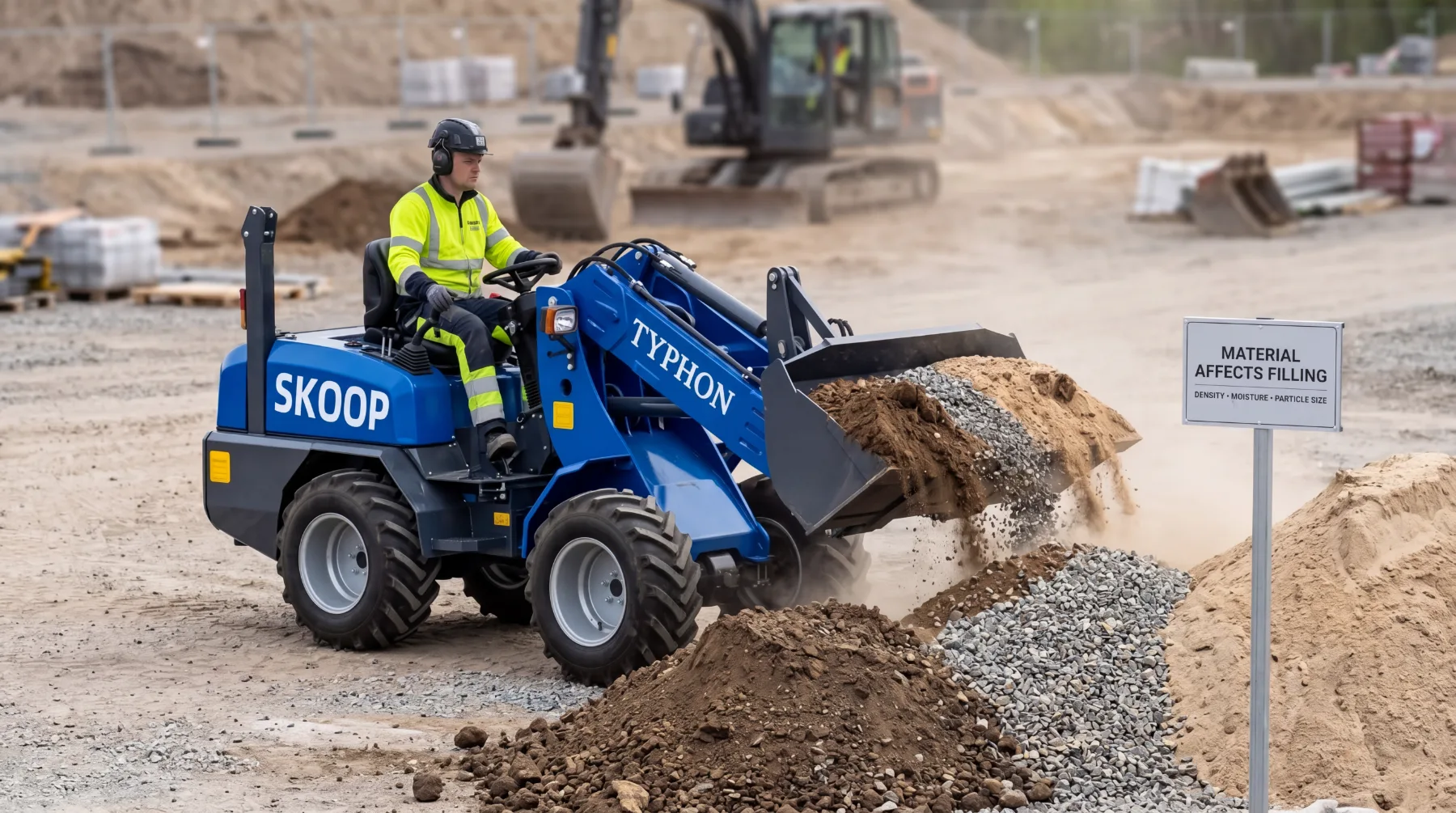
The relationship between them is what makes the fill factor so valuable. A larger bucket means little if it rarely fills, and a fast cycle time counts for less if each cycle carries a light load. When the fill factor rises, every other factor becomes more productive, because each cycle moves more material without taking any longer. This is the heart of why bucket utilization deserves attention.
- Bucket capacity sets the volume the machine can carry per pass
- Fill factor determines how much of that capacity is actually used
- Material density turns the filled volume into payload weight
- Cycle time sets how many loads the machine completes over the shift
The most compelling point is that improving bucket utilization increases the payload carried in each cycle without changing the machine itself. You do not need a larger loader, a bigger engine, or a faster cycle to move more material. By raising the fill factor through the right bucket, sound operator technique, and an understanding of the material, you get more from the equipment already on the job. That gain in payload per cycle, repeated across every load in a shift, adds up to a meaningful increase in total productivity, delivered from the same machine, the same fuel, and the same working hours.
Conclusion
Bucket fill factor is one of the most practical measures of how well a wheel loader is truly performing. It describes how much of the bucket's rated volume is actually put to work each cycle, and raising it means moving more material with every pass. The material you handle influences how easily the bucket fills, the right bucket design helps material enter and stay put, and skilled, consistent operator technique captures fuller loads cycle after cycle. Above all, the fill factor works together with capacity, cycle time, and density to shape total output.
The clearest advantage is that better bucket utilization increases payload without changing the machine at all. Before investing in larger equipment, take an honest look at your current fill factor, the buckets you run, the materials you handle, and how your operators load. Improving these factors gives you more material moved, lower cost per ton, and stronger productivity from the loader already on your site.
Frequently Asked Questions
1. What exactly is the bucket fill factor and how is it measured?
Bucket fill factor describes how much of a bucket's rated volume is actually filled with material during a loading cycle. Every bucket has a rated capacity, but that figure represents an ideal rather than a guarantee of what the bucket carries in real conditions. Fill factor expresses the actual load as a proportion of that rated volume, so a bucket filled to its full designed capacity achieves a fill factor of one hundred percent, while one that comes up short falls below that mark. It matters because the more of the bucket's capacity you use on each pass, the more material you move per cycle. A higher effective fill means each trip from the pile to the truck carries a larger payload, so the machine accomplishes more work in the same number of cycles. Over a full shift, this difference compounds into a significant gain in output. Two loaders with identical bucket capacities working the same material can perform very differently if one consistently fills its bucket more fully than the other, moving more material, finishing sooner, and using less fuel per ton.
2. How does material type affect how well a bucket fills?
Material type has a direct effect on bucket filling because loose soil, gravel, sand, and other materials each behave differently when loaded. Some flow readily into the bucket and settle densely, producing a full, heavy load with little effort, while others resist entry, bridge across the opening, or leave voids that keep the bucket below its rated volume. Several properties drive this behavior. Density determines how much a given volume weighs, so a dense material fills the bucket with a heavier payload while a light, bulky material may fill the volume without reaching the machine's weight capacity. Moisture influences whether material flows freely, clumps, or sticks, since damp material can help a load stay together but may also cling and reduce what the bucket carries. Particle size matters too, because fine, uniform material tends to pack well, while large, irregular pieces can bridge and leave gaps. These factors rarely act alone, so wet sand loads nothing like dry gravel. Recognizing how your material behaves lets you set realistic fill expectations and give the machine the best chance at a full load.
3. Can changing the bucket really improve fill factor?
Yes, bucket design has a strong influence on fill factor because shape, capacity, cutting edge, and linkage geometry all affect how material enters the bucket and how well it stays there. A bucket suited to the material loads cleanly and holds its contents, while a poorly matched one struggles to fill and spills part of its load before reaching the truck. The bucket's shape guides material toward the back and fills the volume evenly rather than leaving voids in the corners. Capacity must suit both the material and the machine, since a bucket too large for a dense material may never fill safely, while one too small wastes potential on every pass. The cutting edge shapes how the bucket enters the pile, with a suitable edge penetrating cleanly and directing material up and in. Linkage geometry controls how the bucket curls and lifts through the loading motion, capturing material and keeping it secure as the machine travels. When these elements align, material enters easily, settles fully, and stays put, which raises the fill factor without altering the loader itself.
4. How much does operator technique influence bucket fill?
Operator technique has a considerable influence on bucket fill, because approach speed, bucket angle, lift timing, and overall loading technique all affect how effectively the bucket captures material. Even a well-designed bucket working ideal material will underperform if the operator's technique works against it, while a skilled operator can consistently draw full loads from the same machine. Approach speed affects how the bucket enters the pile, since too little momentum leaves the bucket short while too much can cause the machine to ride up or stall. Bucket angle at entry determines how cleanly the bucket penetrates and begins to fill, and lift timing matters because coordinating the lift and curl at the right moment scoops material fully into the bucket. Loading technique ties these actions into a smooth, deliberate motion that fills the bucket more completely than a rushed or hesitant approach. Consistency is just as important as skill, since applying the same sound technique on every cycle keeps fill factor predictable. This makes cycle performance easier to plan, which is why training operators in consistent technique pays off across an entire operation.
5. Why does improving fill factor matter if I can just buy a bigger loader?
Improving fill factor matters because it increases the payload carried in each cycle without changing the machine itself, which is often a far more cost-effective path than buying larger equipment. Fill factor works together with bucket capacity, cycle time, and material density to determine total output. Bucket capacity sets the volume available, fill factor determines how much of that volume gets used, density converts that volume into weight, and cycle time governs how many loads the machine completes. A larger bucket means little if it rarely fills, and a fast cycle counts for less if each load is light. When fill factor rises, every other factor becomes more productive, because each cycle moves more material without taking any longer. This means you can gain meaningful productivity from the loader already on your site by choosing the right bucket, training operators in sound technique, and understanding the material you handle. That gain in payload per cycle, repeated across every load in a shift, adds up to more material moved from the same machine, the same fuel, and the same working hours.