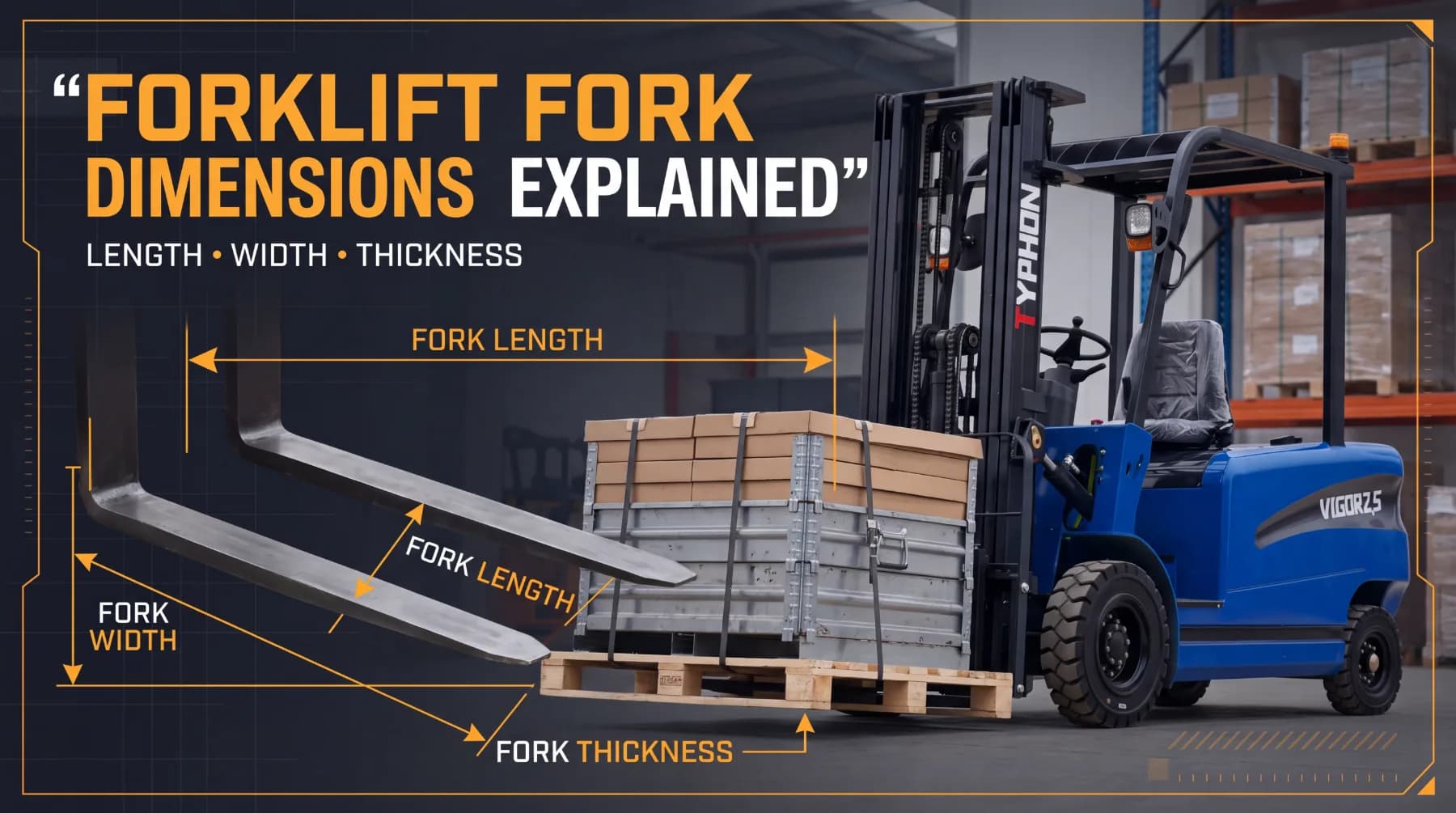
Forklift forks look simple, yet their dimensions carry a heavy responsibility. The length, width, thickness, and shape of the forks decide how safely your machine lifts, how stable your loads sit, and how much weight the truck can handle without risk. Choosing the wrong forks can undermine even a well-built forklift, while the right ones protect your loads, your operators, and your equipment. This guide walks you through the key fork dimensions every buyer should understand, so you can match forks to your forklift and your work with confidence.
Fork Length Determines Load Support
Fork length controls how far the forks reach beneath a pallet or load, and that reach has a direct effect on how well the load is supported. Forks that are too short leave part of the pallet unsupported, which shifts the balance forward and raises the risk of the load tipping or slipping off during a lift. Forks that extend properly beneath the load carry the weight across their full length, keeping it stable and secure as the machine raises, tilts, and travels.
Getting the length right means matching the forks to the loads you actually handle. The forks should reach far enough to support the majority of the pallet or load without leaving a large portion hanging off the tips. At the same time, they should not extend so far that they create unnecessary overhang on the other side, which can strike adjacent pallets, damage goods behind the load, or make maneuvering in tight aisles more difficult.
Consider a few practical points when weighing fork length:
- Pallet depth: the forks should support most of the pallet's depth for stable lifting.
- Double-deep handling: deeper storage or double pallets may call for longer forks sized to the task.
- Overhang control: avoid excessive length that causes the tips to protrude and risk striking other loads.
The correct length provides enough support without creating problems on either end. When forks are sized to your typical loads, the machine lifts securely and handles predictably. When they are too short or too long, you invite instability, product damage, or awkward handling that slows the work. Choosing length carefully is one of the simplest ways to protect both your loads and your operation's efficiency.
Fork Width Affects Load Stability
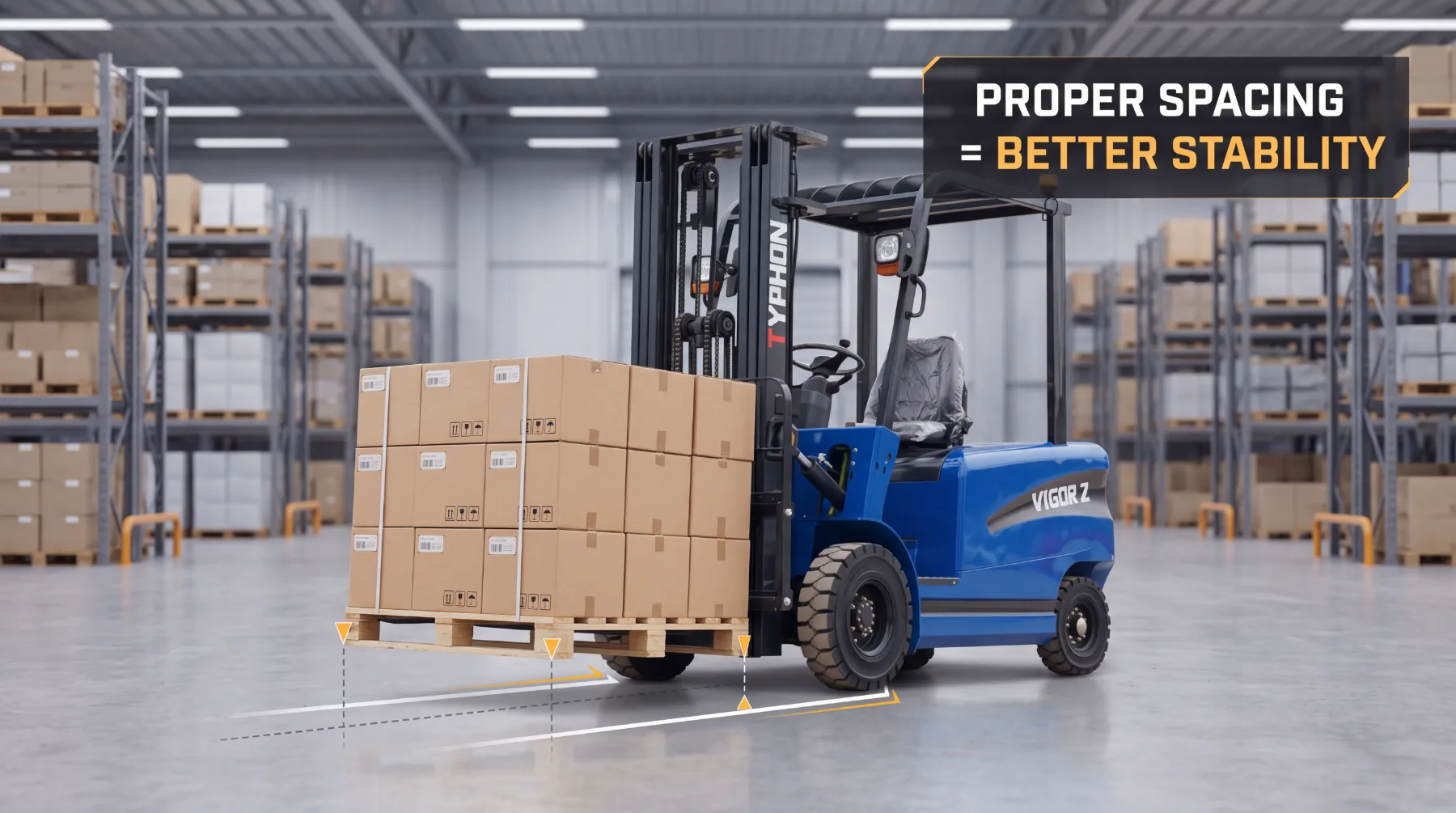
Fork width and spacing play a major role in how securely a load sits during lifting and transport. The width of each fork blade, together with how far apart the forks are positioned on the carriage, determines how the load's weight is distributed across the pair. When the forks are spaced correctly beneath a pallet, the weight spreads evenly, and the load rides steadily as the machine moves. When spacing is too narrow or too wide, the load can become unbalanced and prone to shifting.
Proper spacing is about supporting the load as broadly as its design allows. Positioning the forks toward the outer edges of the pallet's fork openings gives the load a wider, more stable base, much like a person standing with feet apart rather than close together. This even distribution reduces the chance of the load leaning, twisting, or sliding, especially during turns, stops, and travel over uneven surfaces.
Several factors influence how width and spacing affect stability:
- Fork spacing: setting the forks near the outer pallet openings creates a wider, steadier base.
- Blade width: the width of each blade should suit the pallet openings and the load it carries.
- Even weight distribution: balanced spacing keeps the load's weight shared evenly across both forks.
Adjusting fork spacing to each load pays off in safer, smoother handling. A load balanced across properly spaced forks resists the movement that leads to spills and damage, while a poorly positioned load can shift the moment the machine turns or brakes. Operators who take a moment to set the correct spacing before lifting protect both the goods and everyone working nearby. Width and spacing may seem like small adjustments, but they have a direct effect on how stable and secure every lift feels.
Fork Thickness Relates to Load Capacity
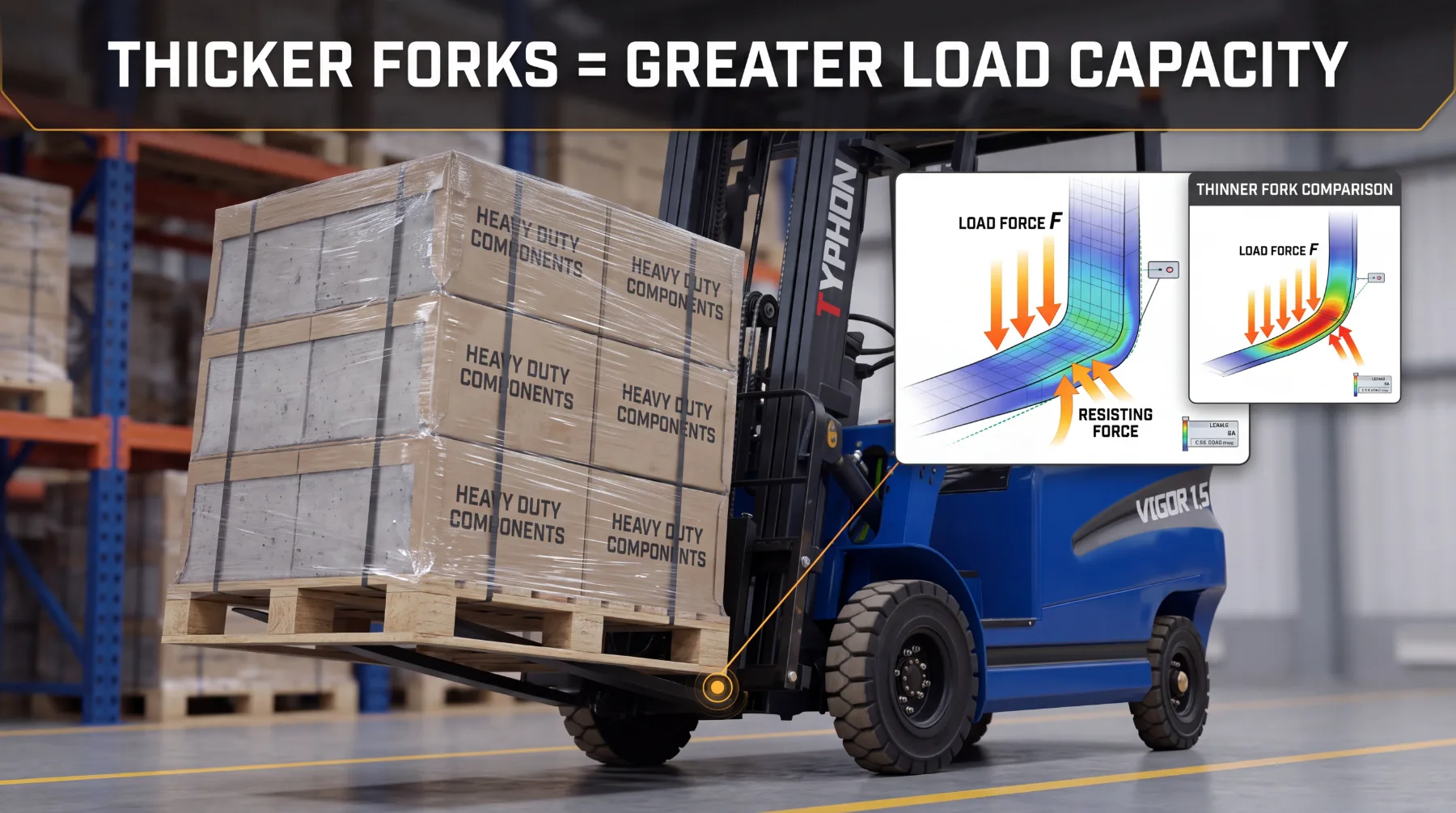
Fork thickness is closely tied to how much weight the forks can safely carry. Thicker forks are engineered to withstand greater load forces without bending or deforming, while thinner forks suit lighter duties. This is not a matter of appearance. The thickness of the fork's vertical shank and horizontal blade is designed to handle specific load forces, so the forks resist bending under the weight they are rated to carry. Matching thickness to the job is essential for safe, reliable lifting.
When forks are asked to carry more than their thickness was designed for, problems follow. Overloaded forks can bend permanently, which weakens them and creates an unsafe tool that may fail without much warning. Even before permanent damage occurs, forks flexing under excessive weight make loads harder to control and place accurately. This is why buyers should never assume that forks fitting the carriage are automatically strong enough for the intended loads.
The safe approach is to match fork dimensions to the forklift's rated capacity and your intended applications. If your work involves heavy, dense loads day after day, your forks must be thick enough to handle that weight repeatedly without strain. Lighter, occasional loads place less demand on the forks, though the dimensions should still suit the rated capacity of the machine. Thinking through your heaviest routine loads, rather than just the average, gives you a clearer picture of the fork thickness your operation truly needs. When thickness is properly matched to capacity and application, the forks carry their loads dependably shift after shift, resisting the bending that leads to damage and downtime. Choosing thickness with your real workload in mind is a straightforward way to protect both safety and productivity.
Fork Cross-Section Affects Strength
Beyond simple thickness, the fork's cross-sectional shape and size contribute significantly to its overall strength. The cross-section describes the profile of the fork blade and shank, and it determines how well the fork resists bending and twisting under load. A larger, well-proportioned cross-section spreads stress more effectively and stands up to heavy forces, while a smaller cross-section is suited only to lighter work. For demanding applications, the cross-section matters just as much as raw thickness.
Two types of force act on forks during lifting. Bending force pushes the blade downward under the weight of the load, and twisting force can come into play when a load is off-center or handled unevenly. The fork's cross-sectional design is what allows it to resist both. A fork engineered with an appropriate cross-section holds its shape under these stresses, keeping loads level and secure. A fork with an inadequate cross-section may flex or twist, which compromises control and can lead to premature wear or failure.
This is why heavier-duty applications typically require appropriately sized and rated forks. The heavier and more demanding the work, the more the cross-section has to contribute to the fork's ability to carry loads without deforming. Buyers handling substantial loads, working long shifts, or operating in tough conditions should give careful attention to fork ratings that reflect the right cross-sectional strength for the task. Selecting forks whose cross-section suits the workload ensures the tool performs safely and holds up over time. When the cross-section is matched to the demands placed on it, the forks resist bending and twisting reliably, protecting your loads and extending the working life of the forks themselves. It is a detail that separates forks that merely fit from forks that truly perform.
Fork Dimensions Must Match the Forklift
A common and costly mistake is assuming that forks are interchangeable simply because they slide onto the carriage. Fitting the carriage is only the starting point. Forks must also match the forklift's mounting class, its rated capacity, and the specific dimensions the machine and application require. Overlooking any of these can leave you with forks that physically attach yet fail to perform safely or as intended.
Fork mounting class is a key part of compatibility. Forklift carriages and forks are grouped into standardized classes based on the machine's capacity, and the fork's mounting must correspond to the correct class for a proper, secure fit. Beyond the class, the rated capacity of the forks has to align with the forklift and the loads you plan to handle. Forks rated below the machine's working demands create a weak link that undermines the whole system, no matter how capable the forklift itself may be.
Before purchasing, buyers should confirm several details:
- Mounting class: verify the fork mounting class matches the forklift's carriage.
- Rated capacity: ensure the forks are rated for the loads and the machine's capacity.
- Dimensions: check that length, width, and thickness suit your pallets and applications.
- Compatibility: confirm the forks are approved for use with your specific forklift.
Taking the time to check these factors protects your investment and, more importantly, the safety of your operation. Forks that match the forklift in class, capacity, and dimensions work together with the machine as a balanced, dependable system. Forks chosen on fit alone can introduce hidden risks that surface at the worst possible moment. Confirming compatibility before you buy is the surest way to get forks that perform reliably from the first lift onward.
Conclusion
Fork dimensions may seem like a small detail, but they shape the safety, stability, and reliability of every lift your forklift makes. Length determines how well loads are supported, width and spacing keep them stable, thickness and cross-section provide the strength to carry weight without bending, and proper matching to the forklift ties it all together. Forks are never interchangeable on fit alone. Before you buy, confirm the mounting class, rated capacity, dimensions, and compatibility with your machine and your loads. Choose forks that match your real work, and your forklift will handle its loads securely and dependably for years to come.
Frequently Asked Questions
1. How do I choose the right fork length for my loads?
Fork length should provide enough support beneath your pallets or loads without creating unnecessary overhang. As a general rule, the forks should reach far enough to support most of the pallet's depth, keeping the weight balanced and secure during lifting and travel. Forks that are too short leave part of the load unsupported and prone to tipping, while forks that are too long can protrude beyond the load, striking adjacent pallets or making tight maneuvering difficult. Consider your typical pallet size and any special handling, such as double-deep storage, then match the length to those loads.
2. Why does fork width and spacing matter for load stability?
Fork width and spacing determine how a load's weight is distributed across the two forks. When the forks are spaced correctly beneath a pallet, usually toward the outer fork openings, the load sits on a wider, more stable base, much like standing with your feet apart. This even distribution reduces the risk of the load leaning, twisting, or sliding during turns, stops, and travel over uneven ground. Spacing that is too narrow or too wide leaves the load unbalanced and more likely to shift. Adjusting the spacing to each load before lifting keeps handling safer and smoother.
3. How is fork thickness related to load capacity?
Fork thickness is engineered to handle specific load forces without bending or deforming. Thicker forks withstand heavier loads, while thinner forks suit lighter duties. If forks carry more weight than their thickness was designed for, they can bend permanently, creating an unsafe tool that may fail with little warning. Even short of permanent damage, flexing forks make loads harder to control. This is why you should match fork dimensions to the forklift's rated capacity and your intended applications, sizing the forks around your heaviest routine loads rather than the average, so they carry weight dependably over time.
4. What is fork cross-section, and why does it affect strength?
The cross-section is the profile of the fork blade and shank, and its shape and size determine how well the fork resists bending and twisting under load. Bending force pushes the blade down under the load's weight, while twisting force can occur with off-center or uneven loads. A larger, well-proportioned cross-section spreads stress effectively and holds its shape under these forces, keeping loads level and secure. A smaller cross-section suits only lighter work. Heavier-duty applications typically require appropriately sized and rated forks, so buyers handling substantial loads should give the cross-sectional strength close attention.
5. Are forklift forks interchangeable if they fit the carriage?
No. Fitting the carriage is only the starting point, not proof of compatibility. Forks must also match the forklift's mounting class, its rated capacity, and the dimensions your loads and application require. Forks rated below the machine's working demands create a weak link that undermines the entire system, even on a capable forklift. Before purchasing, confirm that the mounting class matches the carriage, the rated capacity aligns with your loads, the dimensions suit your pallets, and the forks are approved for your specific machine. Checking these details protects both your investment and the safety of your operation.